
The Household Reference Who?
Gendered home-economics are mostly out of date

Who looks after the grocery shopping in your household? Or spending on things like going out, or TV subscriptions? What about the bigger picture stuff – the mortgage, the rent, insurance?
If you’re in a couple, chances are you both do (or both think you do). More than 80% of men and women who are in couples say that for bigger financial decisions, both partners have equal say. That’s increased substantially – and consistently – over the past 15 years, as the data below demonstrates.
This is a slow moving but positive change towards domestic financial equality. Only 20 years ago more than a third of households were distinctly one sided when it came to home economics. Now, that’s fewer than one in five.
It’s been a long road to get here. Only in 1975 (after the introduction of the Sex Discrimination Act) were women allowed to open a bank account solely in their name. That same act also prohibited discrimination against women seeking to obtain goods, facilities or services, including loans or credit. Before then, single women would need a signature from their father if they wanted to apply for a loan or credit card, whilst married women would need their husband’s signature. The act also allowed women to get a mortgage of their own.
But legal equality didn’t mean decision making parity, and brands and policymaker assumptions about household spending remained – perhaps remains – highly gendered. This report title from Ipsos and the TV Licensing Authority is from 1999 and hasn’t aged well (write up available on the Ipsos website here).
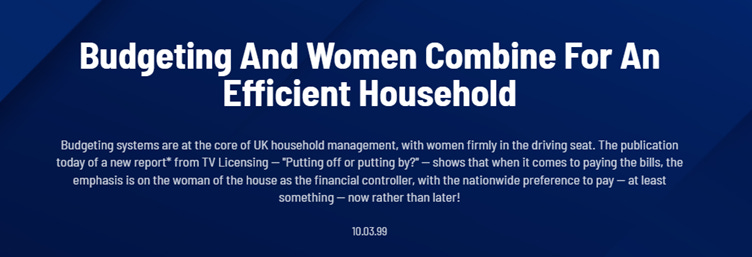
Here’s an excerpt from the piece:
“Central to the financial stability of all households, however, is the role of the woman, who generally prefers to avoid trouble by paying bills regularly to enjoy a “quiet life” without the threat of fines or prosecution. Men on the other hand, are prone to a more carefree and laid back attitude to paying their way, with more than a quarter agreeing that they have very little involvement in the management of the household expenses.”
Ouch. The tone is that of a nature documentary voiceover (seriously, try imagining David Attenborough reading that first sentence) and the conclusions are pure stereotypes. But it isn’t just communication missteps – some of these issues are category ones. Until 2001, the ONS’s definition of household reference person (then ‘head of household’) automatically defaulted to the husband or male partner.
This turn-of-the-millennium climate perhaps explains why the data in the chart above shows effectively no change in domestic financial decision parity (DFDP) until about 2014, when things finally started picking up.
That said, there are some fascinating dynamics still at play in data from 2026. Earlier this year Trajectory collected new data on household spending and decision-making dynamics. The results suggest that within heterosexual couple households, gender plays a role in financial decisions, but that this varies widely by category of spending.
Women are more likely to be main decision maker on groceries. 53% of women, and 37% of men say they are the main decision makers on groceries and everyday items
Men dominate in financial products – 45% of men say they mainly decide on decisions about mortgages and rent (compared to 29% of women) and 57% of men say they are the chief decision maker when it comes to insurance and credit cards (compared to 38% of women).
Men are also the most likely to lead on decisions about which TV subscriptions to get. 50% of men, and just 35% of women say they are the main decision makers here.
In all categories, around half of respondents say that decisions are made jointly.
Much more data on all of this, including how the spending and decision making dynamics break down by age as well as gender, are available in our subscriber report.
What does this mean?
Slow change and no change. The world is a volatile place but this isn’t one of those things that is changing rapidly. The progress towards domestic financial decision parity in heterosexual couple households is a very slow moving one. But it is happening. At the same time, some old roles seem to endure: women are more likely to report that they are main decision makers when it comes to groceries, men say the same about insurance.
Spending on demand. An interesting finding from our data is that men take the lead in subscription spending – things like TV subscriptions, but also including subscriptions to magazines, music, newspapers etc. Compared to the other categories we tested, this is likely to be the newest row on the household budget sheet.
Joint accounts. The dominance of shared decision making suggests more complicated purchase journeys than in the past. It means more options might be considered, and more considerations in the first place. It might ultimately mean better outcomes. For brands and service providers, understanding the specific dynamics within households both generally and with regard to a specific category is key.
Household reference what? The very idea of a household reference person – or head of household – seems outdated. The concept is an unwelcome hangover from a time when there was an automatic point of financial authority with a household – the oldest man – and shouldn’t still be the basis for understanding spending and decision making dynamics.
More than this
Trajectory monitor trends in household spending, social values, environmental behaviours, politics, economics, society, tech and much more. We work with clients on bespoke projects and publish reports, analysis and data on our Now & Next subscription service.
Membership of Now & Next gets you:
✅ All Optimism Index outputs - your monthly update on how consumer attitudes, spending and behaviours are changing
✅ Our continually updated Horizon Scan, allowing you to contextualise and prepare for whatever 2026 and beyond will throw at us
✅ The whole Trajectory archive of trends content, insight and foresight, including our trends briefing archive on demand, all our deep-dive reports and articles, and the Trajectory Macro Trends.
There are membership options for every budget, starting at £500p.a. You can find out more here.